



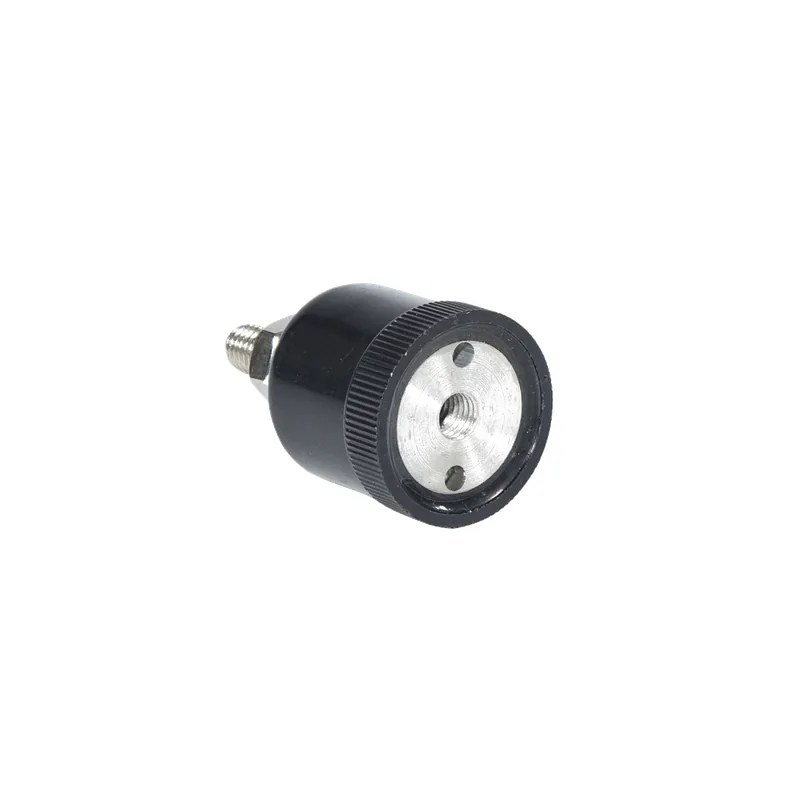
Disconnector
Overview
The disconnector is a special accessory of the surge arrester, used in series with it. When the arrester fails it operates quickly to remove the failed arrester from the network and at the same time gives a clear disconnection indication, enabling maintenance personnel to locate the fault and replace the arrester. On the other hand, when the arrester operates normally the disconnector does not operate and presents a low impedance, without affecting the protective characteristics of the arrester. With a disconnector fitted, the arrester automatically disconnects on failure, making it easy for maintenance personnel to find and replace it in time and reducing the maintenance workload. Disconnectors are widely used with distribution-type, station-type and line-type arresters in the networks of developed countries and regions such as Europe, America and Japan.
Our disconnector adopts a new thermal-explosion design with the advantages of fast response and no maloperation, and can be used with various types of arresters above 3 kV. The service conditions are the same as those of the arrester.
Typical time-current characteristic of the disconnector
| Current (A) | 800 | 200 | 20 | 5 | 0.5 | 0.05 |
|---|---|---|---|---|---|---|
| Operating time (s) | 0.01-0.02 | 0.02-0.05 | 0.1-0.2 | 0.5~1.0 | 20-50 | 200-500 |
The conventional installation methods of the disconnector are shown in the figure above; other installation methods may be used under special conditions according to the actual situation.
For detailed description and use of the disconnector, please refer to our dedicated disconnector instruction manual. If the arrester is fitted with a disconnector, the letter “L” is added after its standard model designation; for example, HY5WS-17/50-L indicates that a disconnector has been added to the HY5WS-17/50 arrester.

Related Products
Metal-oxide surge arresters of the same series and other types available for selection: